Table Of Content

We know the content so well and have taught the material many times but suddenly we get stuck when planning the course. Do you have a final exam surrounding a few modules from a book or from an online class? Make sure that the exam has a section for each module so students can study the entire course’s material from start to finish. Since its publication in the 1990s, Understanding by Design has evolved in series of popular books, videos, and other resources. If you're an Ohio State educator looking for more support with course design, there are a number of resources at your disposal. In addition to browsing our growing repository of teaching topics, we encourage you to explore the following professional development activities.
Center for Innovative Teaching and Learning
This planning involves identifying learning materials, activities for students to complete inside or outside of class, and what teaching strategies you will use. The key element in Backward Design is alignment; activities need to support the learning outcomes and prepare students for successful performance on the assessments, and the assessments must directly align with the outcomes. Research shows that retrieving and using information is a critical piece of achieving learning (Karpicke & Roediger, 2008). As such, students must have multiple opportunities to practice and apply the specific knowledge and skills they need to perform well on assignments and be successful in your course. Reflect on your assessments of student learning from Step 3 to determine the teaching methods and learning activities that will best support students to succeed.
Flipped Classroom
Permaculture Design as a Pedagogical Resource - resilience - Resilience
Permaculture Design as a Pedagogical Resource - resilience.
Posted: Wed, 08 Nov 2017 08:00:00 GMT [source]
If the teacher has explicitly defined the learning goals of the course, then they have a better idea of what they want the students to get out of learning activities. Furthermore, if done thoroughly, it eliminates the possibility of doing certain activities and tasks for the sake of doing them. Every task and piece of instruction has a purpose that fits in with the overarching goals and goals of the course. Your learning outcomes should be achievable for the students in your class and achievable in the time allotted to your subject.
How To Hire Freelancers To Help Create & Market Your Online Course
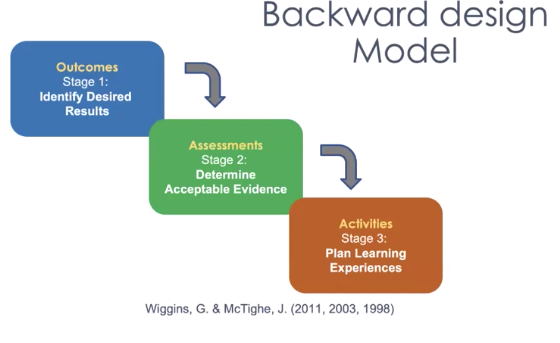
The challenge with this approach is that traditional design overlooks and neglects the course outcomes and how a student might achieve them resulting in lackluster results and engagement. The teacher first considers the knowledge and skills that students will need in order to complete the authentic assessment. Specifically, students will need to know about different food groups, human nutritional needs (carbohydrates, proteins, sugars, vitamins, minerals etc.), and about what foods provide these needs. Resources will be a pamphlet from the UDSA on food groups, the health textbook, and a video "Nutrition for You".
Stage Two – Determine Acceptable Evidence:
An undergraduate’s level of “understanding” of a topic and that of the instructor will vary wildly, and it will be difficult for students to know which level of understanding they should be aiming for. When developing ILOs, ask yourself how you will know that a student “understands” the material – what will they need to do, or say to demonstrate their understanding? Your answer to this question should provide you with more specific (and measurable ILOs. Both the Dick and Carey model and the backward design model are goal and objective oriented; assessment is created based on learning objectives and goals, and instruction is created based on evaluation and assessment. The Dick and Carey model, however, is a more systemic model in that making changes to components affects other components and, therefore, the changes occur in parallel. In the more linear backward design model, the steps are non-flexible which means that skipping or changing steps is not an option.
Curriculum design, and instructional design
Finally, the Zone of Proximal Development, a concept introduced by Russian psychologist Lev Vygotsky in the early 20th century, also supports the effectiveness of Backward Design. According to Vygotsky, this "zone" is the gap between what learners can do independently and what they can achieve with guidance. By focusing on the end goals—say, improving customer service or increasing sales—trainers can build a program that really works. No more slogging through boring PowerPoint slides that nobody remembers the next day. Instead, employees get active, engaging training that equips them to do their jobs better. After its introduction, other scholars and educators picked up the concept and ran with it.
Create Your Course
As you backward design your course, you should be planning with all students in mind. Universal Design for Learning (UDL) is a framework for focusing curriculum and course design around the diverse needs of learners. Backward design and UDL are complementary frameworks for course planning, as each are centered on student learning and purposeful, proactive course design. Finally, think about how you can best prepare students to be successful on an assessment and achieving the outcomes.

Using a process like backward design helps us get better at making these decisions. By making this approach part of our regular practice, we’ll be able to look back on a day, a week, or a year of teaching and say with a lot more certainty that when they were under our care, our students learned. The “full” version of Wiggins and McTighe’s original approach is pretty complex and can be time-consuming to implement. For now, though, I’m just going to share the most basic version of backward design. Notice that in this approach, the assessment is created after the lessons are planned. Sometimes it isn’t created until most of those lessons have already taken place.
No more asking, "When will I ever use this?" They know they're learning things that will help them in the future, whether it's acing a job interview or understanding how to budget their money. Backward Design is a way of planning lessons or training sessions by starting with the end goal in mind. Imagine planning a road trip by first thinking about the destination, and then figuring out all the best stops and routes along the way. With this detailed set of ILOs, we see exactly how the three general ILOs in the first section will be measured. Relatively immeasurable outcomes (e.g., “Gain an appreciation…”) are analyzed into the homework and exam tasks through which students can show that they have gained such an appreciation. This second set of ILOs also provides much more detail, specificity, and measurability.
You might hear teachers asking, "What are the desired outcomes?" or "What evidence of learning will we accept?" These questions show that the influence of Backward Design is widespread and still growing. Backward Design is a planning framework in which you start with the end in mind - the desired outcomes. Once you have determined what you want the students to be able to know and do, you’ll define how you will know if the student has achieved those outcomes. In the well-known book The Seven Habits of Highly Effective People, author Dr. Stephen Covey describes seven habits that successful people tend to live by. The second habit is “Begin with the end in mind.” Dr. Covey was suggesting that the most successful people are those who create a vision of the future in their mind.
Set aside specific content—remember, that comes toward the end of the backward design process—and think about the big-picture, lasting impact you want your course to have on students. In a classroom influenced by Constructivist principles, students are actively engaged, asking questions, and building their own understanding. Backward Design aligns with Constructivism by initiating the learning process with a clear objective. Knowing this goal helps learners actively construct the knowledge required to achieve it. On the other hand, if one of your important goals is to help students develop their ability to master mechanical tools, a problem-solving test may not provide you with the type of evidence of progress that you require. The incorporation of backward design also lends itself to transparent and explicit instruction.