Table Of Content
Just like any plan, your initial Backward Design framework may require adjustments. Formative assessment expert Paul Black advocates for continuous improvement through the feedback loop, which involves tweaking the lesson plans based on student performance and other data. Teachers like Carol Ann Tomlinson, known for her work on differentiated instruction, have noted that when students understand what they're working towards, they are often more engaged and motivated. Backward Design’s focus on clear objectives and transparent assessments lets students know what's expected of them, which can enhance their motivation to succeed.
Prioritize Student Understanding
The assessment is kind of an afterthought, a check to see if students were paying attention to the stuff we taught them. And I got to drool over Matt Dillon in the movie’s opening scene again and again and again. Before implementing a new curriculum design strategy like Backward Design, it's often beneficial to consult with school or organizational administrators. Doing so can ensure alignment with broader educational goals and compliance with any applicable standards or regulations.
Steps to Backward Design
According to Piaget, learning is a process where individuals construct knowledge based on their experiences. Your choice of teaching strategies should reflect the levels of thinking and learning in which you want students to be engaged. Complete the Backwards Design Lesson Planning Template to walk through the three stages of the backwards design planning process to plan an upcoming lesson. This should be a lesson that you can implement within the next couple of weeks so that you are able to see the impact this planning process has on student performance.
Backward's Design: Start with the Outcomes
Remember that “students” is the subject of the generic learning outcome stem shown at the beginning of this section. The goals for your course should not be stated in terms of what the instructor will cover, but rather in how the students will change, facilitated by the instructor’s guidance. Six Common Planning Pitfalls – Recomendations for Novice Educators – This article looks at common mistakes made by novice teachers when planning lessons, including planning with no clear objective. Microlearning helps create more impactful learning through efficient, timely, and relevant experiences. Jean Pak is the founder and owner of Jean Pak LLC and a Thinkific Expert and Learning Experience Designer helping businesses develop more interactive and engaging learning experiences. In no time at all, you might see improvements in the performance of your students, the quality of your classes, and the ratings of your online lessons.
Stage Two – Determine Acceptable Evidence:

The right backward design lesson plan may result in a better learning experience for a classroom full of students, a private client, and everyone in between. We’re going to break down what backward design lesson planning is and why you should use it. The primary starting point for backward design is to become familiar with the standards/outcomes for the grade level and curriculum being taught. The second part of curriculum planning with backward design is finding appropriate assessments. It can be difficult for "traditional" educators to switch to this model because it is hard to conceptualize an assessment before deciding on lessons and instruction.
The idea is that the assessments (formative or summative) should meet the initial goals identified. Students will also need support to know how to prepare for assignments, to evaluate their work, and to understand their performance. Consider how your teaching strategies and learning activities will explicitly prepare students for assignments and how you can provide tangible feedback on their progress. For example, you might present exemplars and non-exemplars of student work, incorporate checklists for self- and peer review, or simply walk through and discuss the assignment instructions and rubrics you develop explicitly with students. At this point, you have determined what students will know and be able to do by the end of your course. The next step is to create opportunities for students to show that they are achieving those learning goals and outcomes.
Contrast with Traditional Forward Design
In 2005, Wiggins and McTighe published a second edition of their book to include new insights and updates. Around the same time, the approach started getting attention from policymakers. Some states in the U.S., like Massachusetts and North Carolina, even began incorporating elements of Backward Design into their educational standards. Instead of starting with the first clue, you begin by planting the treasure—your final learning goal. Criterion – How WELL the learner must perform to demonstrate content mastery.
Create Your Course
For the first time, it felt like none of my class was wasted; everything actually mattered. By beginning with the end in mind, teachers are able to avoid the common problem of planning forward from unit to another, only to find that in the end some students are prepared for the final assessment and others are not. Developed by Maria Montessori in the early 20th century, this method emphasizes student-directed learning in multi-age classrooms. In the Montessori approach, the teacher serves as a facilitator rather than a director of learning. Unlike Backward Design, which is highly structured around pre-set objectives and assessments, Montessori is far more exploratory and driven by the student's own interests. Dr. Benjamin Bloom, who created Bloom’s Taxonomy of learning objectives, often adhered to this method.
The scope of your assessments should be in line with the outcomes, and the balance between concepts and skills in these assessments should match that presented in your ILOs. Moreover, in assessments, you should strive to measure the kind(s) of engagement described in your intended learning outcomes. If your ILO states that students will be able to describe some phenomenon, don’t use a true/false or multiple-choice question to measure their attainment of this outcome.
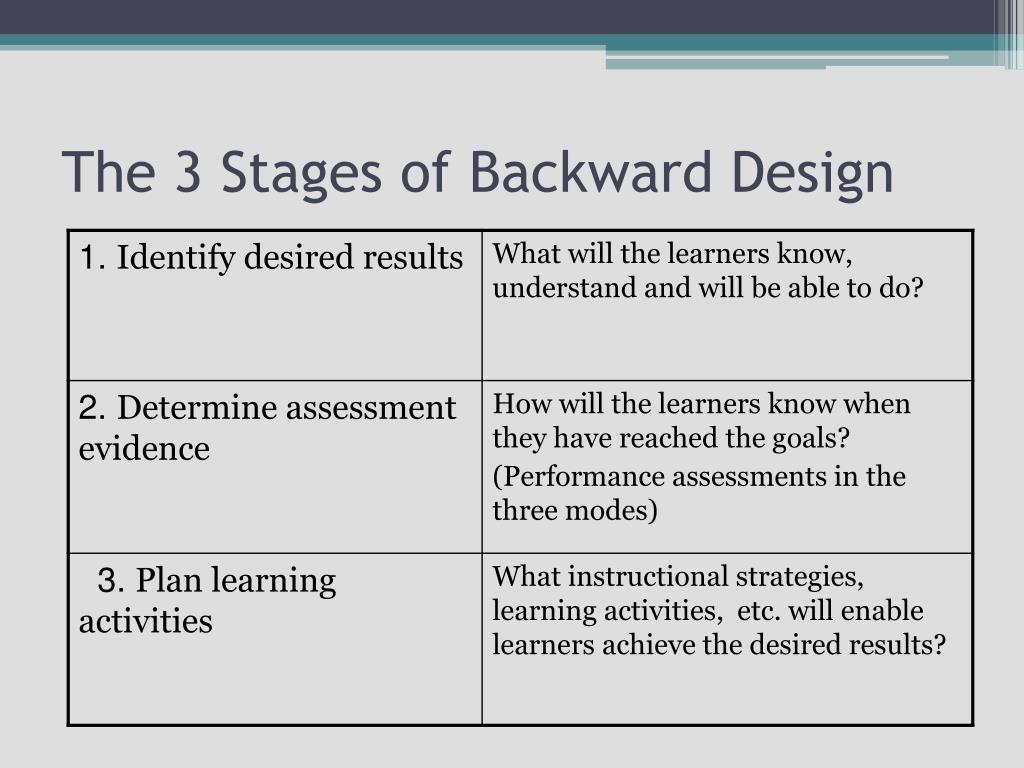
Although backward design has been around for some time (Tyler, 1949), Grant Wiggins and Jay McTighe are often credited with its current prevalence. In Understanding By Design (2005), Wiggins and McTighe explain backward design as a three-stage approach to course planning (p. 17-18). The table below lists these three stages, alongside the tasks and considerations that are central to each stage. With this “after” version, every lesson is designed to prepare students to give excellent presentations at the end. The whole time, they are using the lunar cycle vocabulary, correcting each other’s misconceptions, and just like scientists, thinking about how to explain concepts to other people.
The reason for this is because within the limits of the course, such as time, it is likely that you will need to prioritize certain goals over others to ensure that the most important learning outcomes are achieved. To help you define the curricular priorities for the course, Wiggins and McTighe suggest the following three questions to help you progressively narrow in on and define the most important content areas. At this stage it is important to consider a wide range of assessment methods in order to ensure that students are being assess over the goals the instructor wants students to attain. Sometimes, the assessments do not match the learning goals, and it becomes a frustrating experience for students and instructors. Use the list below to help brainstorm assessment methods for the learning goals of the course.
Greenfield High School principal settles in, crafts vision for future - The Recorder
Greenfield High School principal settles in, crafts vision for future.
Posted: Sun, 06 Feb 2022 08:00:00 GMT [source]
Finally, recycling the assignments from a former course may not always be the best fit for a new course. If it turns out that those favorite lessons don’t really align with any standards, you might be able to revise them so they do. Or you might keep them for other reasons—not every minute of class time has to be spent on standards-based instruction. Some activities have value because they help us get to know each other better, they help students develop social-emotional skills, or they simply offer a bit of fun. But if a lesson doesn’t do any of these things, if it’s disguised as learning but is doing little more than keeping students busy, it’s time for it to go.


No comments:
Post a Comment